









Wir möchten Ihnen eine umfassende hausärztliche Versorgung bieten, die den Menschen als Individuum, seine Einstellungen und seine Wünsche sowie die neuesten Entwicklungen in der Medizin berücksichtigt.
Wir sind freundlich, hilfsbereit und kompetent. Die Medizin in unserer Praxis basiert dabei auf den Prinzipien der Evidenzbasierten Medizin.
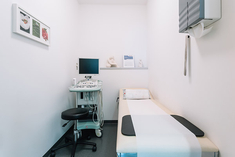
Ein entscheidender Faktor ist die Zeit. Wir nehmen uns Zeit für Sie. Das ist vielleicht nicht immer beim ersten Kontakt möglich, aber dann vereinbaren wir einen weiteren Termin zu einem späteren Zeitpunkt.Unsere Praxis ist mit modernen Geräten für die Diagnostik ausgestattet.
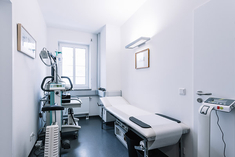
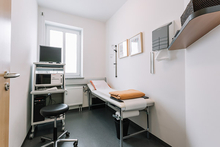
Wir bieten Ihnen die modernen diagnostischen Möglichkeiten der Hausarztpraxis an: Laboruntersuchungen, Sonografie von Bauchraum, Schilddrüse und Gefäßen, Lungenfunktion, EKG, Belastungs-EKG, Langzeitmessungen von EKG oder Blutdruck. Welche technische Untersuchung in ihrem Fall sinnvoll einzusetzen ist, wird in einem Sprechstundentermin erörtert. Sollten Sie vorab Fragen dazu haben, rufen Sie uns bitte an.
In unserer Praxis können Sie sämtliche von der Ständigen Impfkommission (STIKO) am Robert Koch-Institut empfohlenen Impfungen bekommen:
Tetanus, Diphtherie, Keuchhusten, Kinderlähmung, FSME, Pneumokokken, Influenza, RSV (für Personen ab 60 bzw. ab 75 Jahren) etc.
Diese Standardimpfungen sind reguläre Kassenleistungen der gesetzlichen Krankenversicherung und werden über Ihre Versichertenkarte abgerechnet. Sie zahlen hierfür nichts.
Bitte informieren Sie uns vorab…


Darüber hinaus bieten wir Ihnen Impfungen im Rahmen einer Reise an:
Hepatitis A und B, Typhus, Cholera, Meningokokken, Japanische Enzephalitis, Tollwut und weitere.
Wichtiger Hinweis: Die reisemedizinische Beratung sowie Reiseimpfungen sind keine Leistungen der gesetzlichen Krankenversicherung (GKV) und werden als Individuelle Gesundheitsleistungen (IGeL) nach der Gebührenordnung für Ärzte (GOÄ) privat abgerechnet.
Viele gesetzliche Krankenkassen erstatten jedoch freiwillig einen Teil oder die gesamten Kosten für Reiseimpfungen und Impfstoffe. Wir empfehlen Ihnen dringend, sich vor der Beratung bei Ihrer Krankenkasse über die Erstattungsmöglichkeiten zu informieren. Reichen Sie nach der Impfung die Rechnung zusammen mit einem Nachweis über Ihre Reise (z. B. Buchungsbestätigung) bei Ihrer Krankenkasse ein.

Sollten Sie eine reisemedizinische Beratung benötigen, vereinbaren Sie bitte möglichst frühzeitig (idealerweise 2–3 Monate vor Reiseantritt) einen speziellen Sprechstundentermin. Bei kurzfristiger Beratung kann es zu zeitlichen Schwierigkeiten bei der Umsetzung aller empfohlenen Impfungen kommen.
In der gesetzlichen Krankenversicherung haben Sie zwischen 18 und 34 Jahren einmalig in diesem Zeitraum einen Anspruch auf eine Gesundheitsuntersuchung (GU).
Ab 35 Jahren haben Sie dann alle 3 Jahre Anspruch auf die sogenannte GU-35 (Gesundheitsuntersuchung) sowie die Hautkrebsfrüherkennung beim Hausarzt.
Die Gesundheitsuntersuchung beinhaltet neben der ausführlichen körperlichen Untersuchung bereits zwischen dem 18. und 34. Lebensjahr bei bestehendem erhöhtem Risiko für die Entwicklung einer Herz- Kreislauferkrankung, und ab dem 35. Lebensjahr regelhaft, die Bestimmung von Blutzucker, Cholesterin, HDL, LDL, Triglyceride und Urin-Stix (ggf. inklusive der Hautkrebsfrüherkennung). Zusätzliche Untersuchungen können bei medizinischer Notwendigkeit ergänzt werden.
Die Krebsfrüherkennung besteht aus der Testung auf verstecktes Blut im Stuhl (iFOBT) ab dem Alter von 50 Jahren, bzw. der Darmspiegelung ab dem Alter ebenso ab dem Alter von 50 Jahren für Männern und Frauen.
Die Krebsfrüherkennung der Prostata wird dem Mann ab einem Alter von 45 Jahren angeboten.
Da Maßnahmen der Krebsfrüherkennung nicht unproblematisch sind und neben einem möglichen Nutzen auch einen möglichen Schaden verursachen können, empfehlen wir Ihnen, sich vor Inanspruchnahme einer solchen Maßnahme von uns beraten zu lassen.
Die Krebsfrüherkennungsmaßnahmen bei der Frau wird in der Regel bei Ihrem/r Gynäkologen/in durchgeführt.
Dr. Anton Beck - Hausarzt mit Herz und Verstand in Rottenburg an der Laaber
We firmly believe that the internet should be available and accessible to anyone, and are committed to providing a website that is accessible to the widest possible audience, regardless of circumstance and ability.
To fulfill this, we aim to adhere as strictly as possible to the World Wide Web Consortium’s (W3C) Web Content Accessibility Guidelines 2.1 (WCAG 2.1) at the AA level. These guidelines explain how to make web content accessible to people with a wide array of disabilities. Complying with those guidelines helps us ensure that the website is accessible to all people: blind people, people with motor impairments, visual impairment, cognitive disabilities, and more.
This website utilizes various technologies that are meant to make it as accessible as possible at all times. We utilize an accessibility interface that allows persons with specific disabilities to adjust the website’s UI (user interface) and design it to their personal needs.
Additionally, the website utilizes an AI-based application that runs in the background and optimizes its accessibility level constantly. This application remediates the website’s HTML, adapts Its functionality and behavior for screen-readers used by the blind users, and for keyboard functions used by individuals with motor impairments.
If you’ve found a malfunction or have ideas for improvement, we’ll be happy to hear from you. You can reach out to the website’s operators by using the following email
Our website implements the ARIA attributes (Accessible Rich Internet Applications) technique, alongside various different behavioral changes, to ensure blind users visiting with screen-readers are able to read, comprehend, and enjoy the website’s functions. As soon as a user with a screen-reader enters your site, they immediately receive a prompt to enter the Screen-Reader Profile so they can browse and operate your site effectively. Here’s how our website covers some of the most important screen-reader requirements, alongside console screenshots of code examples:
Screen-reader optimization: we run a background process that learns the website’s components from top to bottom, to ensure ongoing compliance even when updating the website. In this process, we provide screen-readers with meaningful data using the ARIA set of attributes. For example, we provide accurate form labels; descriptions for actionable icons (social media icons, search icons, cart icons, etc.); validation guidance for form inputs; element roles such as buttons, menus, modal dialogues (popups), and others. Additionally, the background process scans all the website’s images and provides an accurate and meaningful image-object-recognition-based description as an ALT (alternate text) tag for images that are not described. It will also extract texts that are embedded within the image, using an OCR (optical character recognition) technology. To turn on screen-reader adjustments at any time, users need only to press the Alt+1 keyboard combination. Screen-reader users also get automatic announcements to turn the Screen-reader mode on as soon as they enter the website.
These adjustments are compatible with all popular screen readers, including JAWS and NVDA.
Keyboard navigation optimization: The background process also adjusts the website’s HTML, and adds various behaviors using JavaScript code to make the website operable by the keyboard. This includes the ability to navigate the website using the Tab and Shift+Tab keys, operate dropdowns with the arrow keys, close them with Esc, trigger buttons and links using the Enter key, navigate between radio and checkbox elements using the arrow keys, and fill them in with the Spacebar or Enter key.Additionally, keyboard users will find quick-navigation and content-skip menus, available at any time by clicking Alt+1, or as the first elements of the site while navigating with the keyboard. The background process also handles triggered popups by moving the keyboard focus towards them as soon as they appear, and not allow the focus drift outside it.
Users can also use shortcuts such as “M” (menus), “H” (headings), “F” (forms), “B” (buttons), and “G” (graphics) to jump to specific elements.
We aim to support the widest array of browsers and assistive technologies as possible, so our users can choose the best fitting tools for them, with as few limitations as possible. Therefore, we have worked very hard to be able to support all major systems that comprise over 95% of the user market share including Google Chrome, Mozilla Firefox, Apple Safari, Opera and Microsoft Edge, JAWS and NVDA (screen readers).
Despite our very best efforts to allow anybody to adjust the website to their needs. There may still be pages or sections that are not fully accessible, are in the process of becoming accessible, or are lacking an adequate technological solution to make them accessible. Still, we are continually improving our accessibility, adding, updating and improving its options and features, and developing and adopting new technologies. All this is meant to reach the optimal level of accessibility, following technological advancements. For any assistance, please reach out to